BELTA

BELTA - Zgrzewarka HF/RF do produkcji taśm transmisyjnych, zabieraków i profili

BELTA

High frequency welding machine for conveyor belt production, cleats and profiles

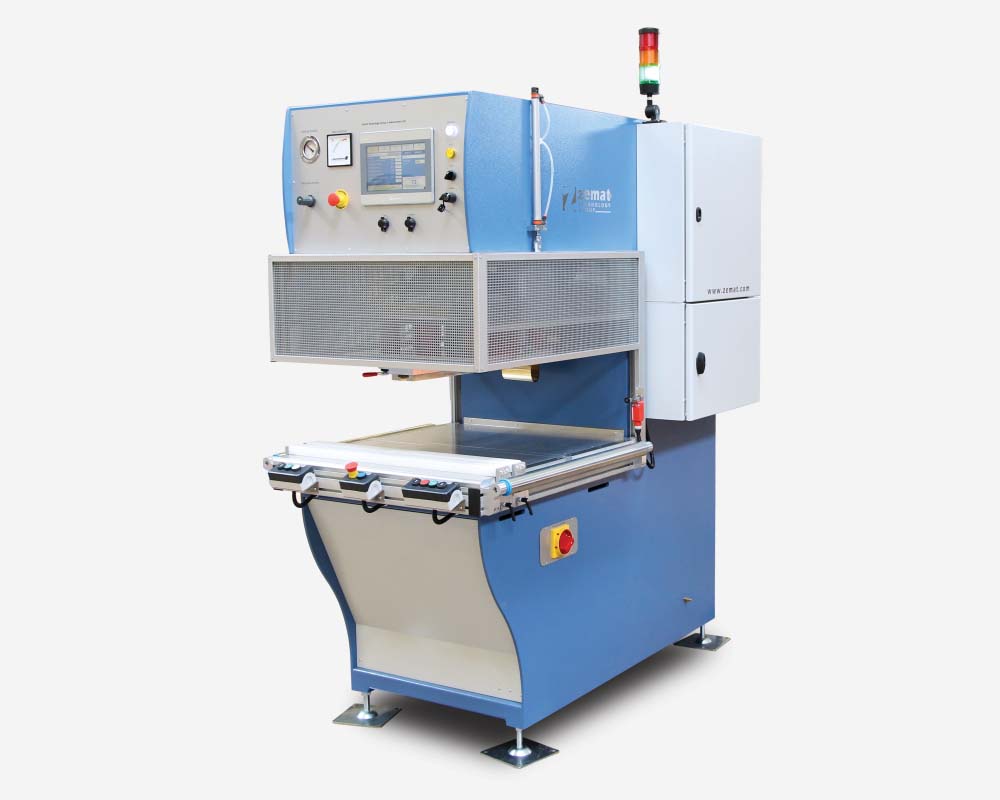
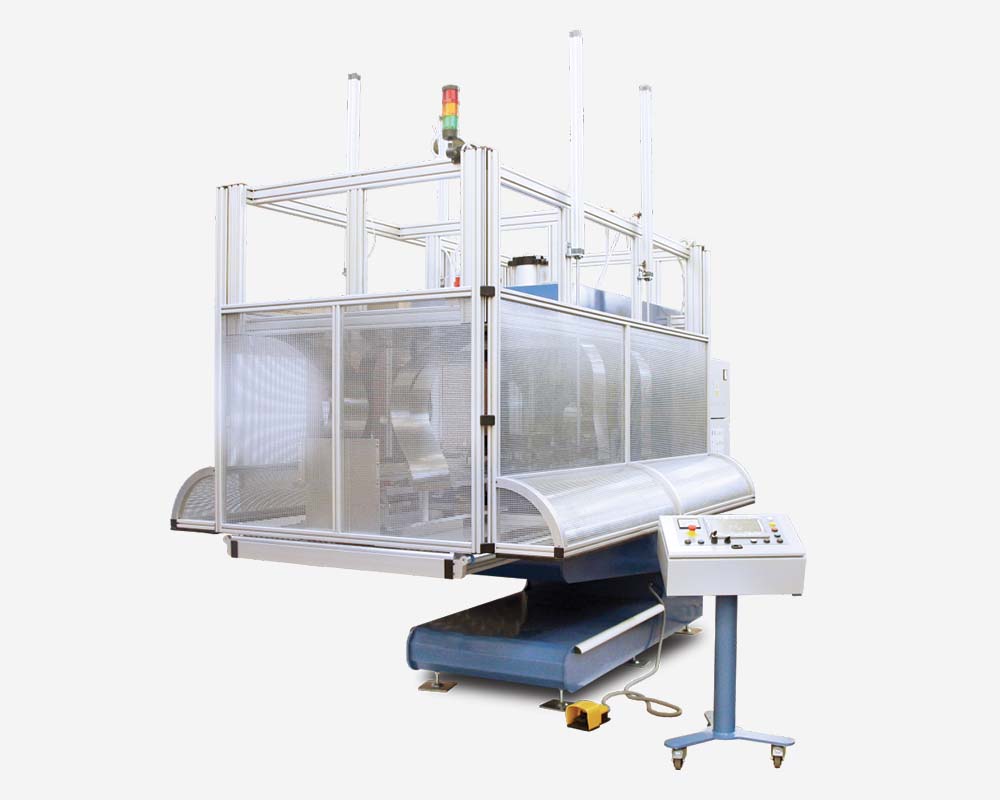
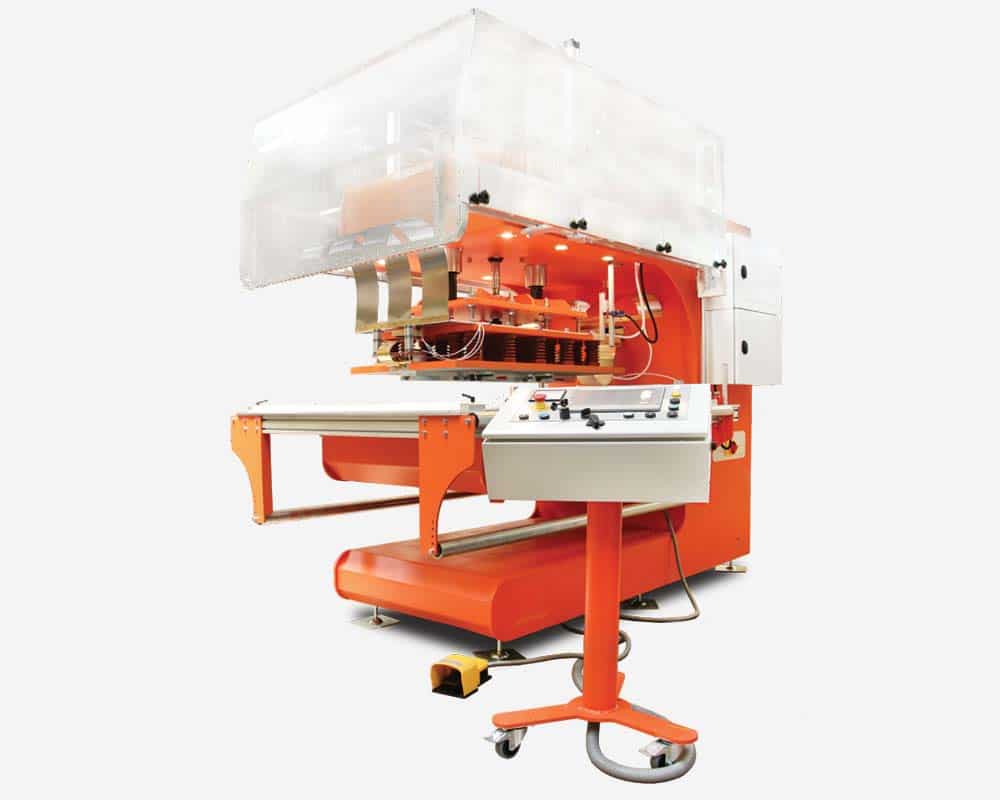
BELTA is a series of HF/RF conveyor belt welders designed for conveyor belt production processes that require strong, repeatable welds and precise positioning of components on the belt.

  • for PVC, PU, TPU and TPE conveyor belts
  • for cleats, profiles, guides and corrugated sidewalls
  • 360° electrode rotation
  • work tables and plates adapted to production requirements
  • configurations from 10 to 30 kW
Machine Overview

Flexible conveyor belt production with repeatable HF/RF welding

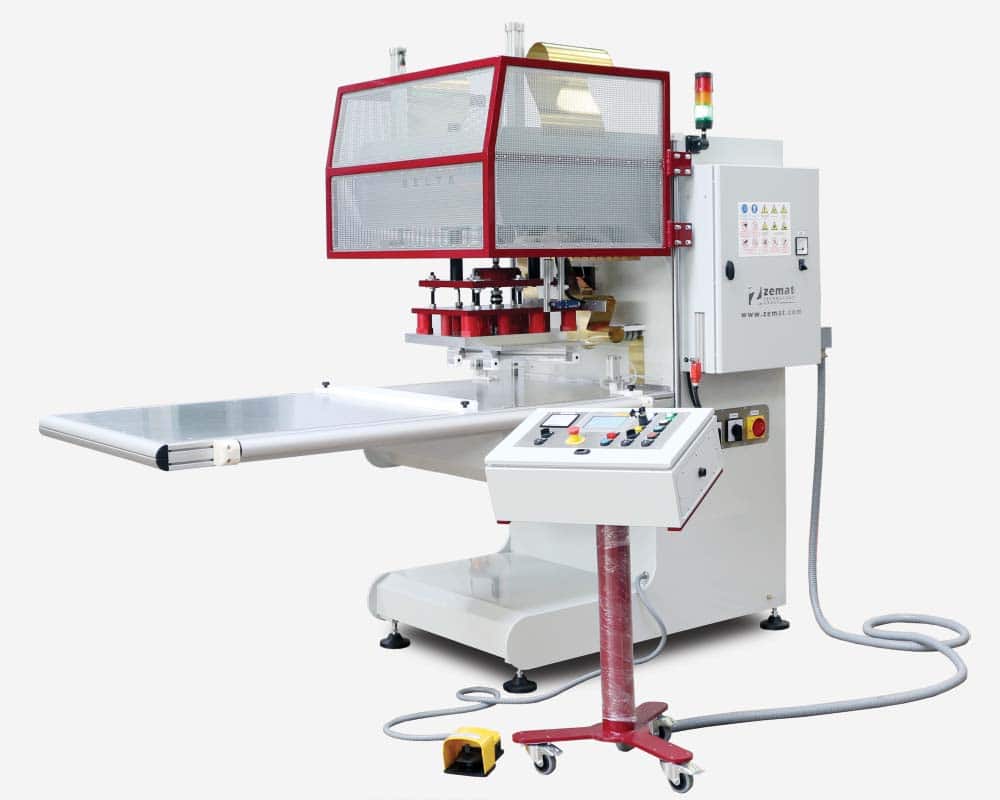
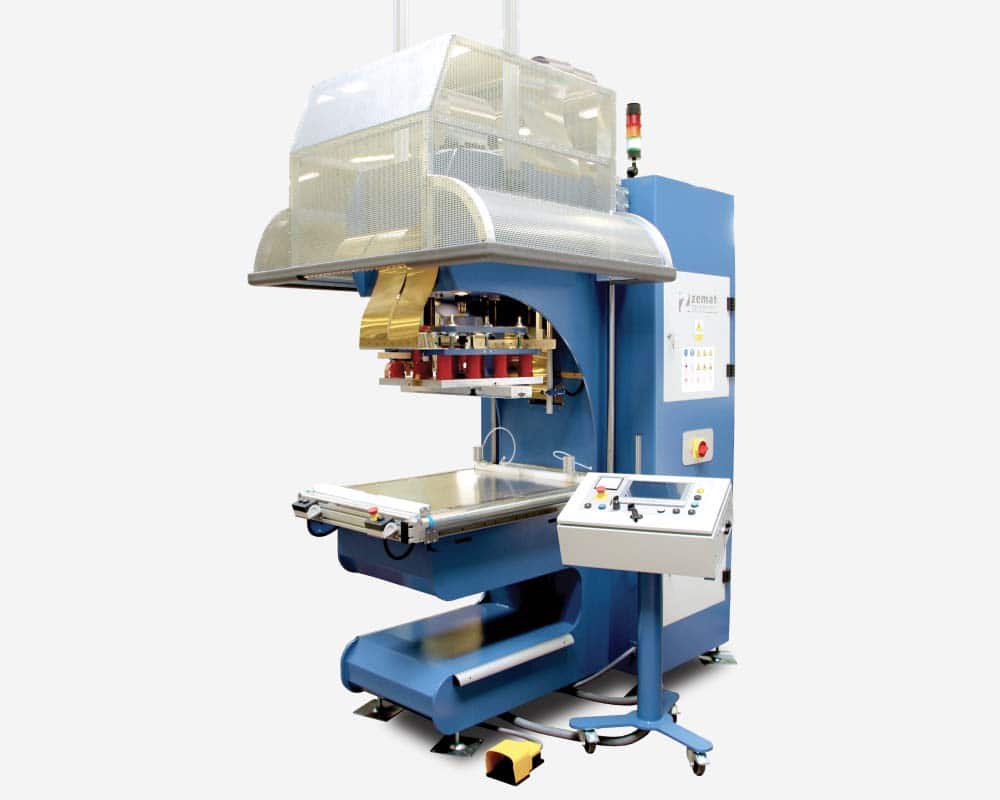
BELTA – Conveyor belt welding machines machines designed to make the production of different belt configurations more efficient and repeatable. They enable cleats, timing belts, profiles, guides, stops and corrugated sidewalls to be welded onto PVC, PU, TPU and TPE belts with consistent positioning and weld quality.

A large work table, 360° electrode rotation and application-specific tooling give operators greater freedom when working with different belt widths, profile layouts and welding angles. Long and heavy belts can be positioned more comfortably, while the machine configuration can be adapted to the required clamping force and production workflow. This helps reduce handling time, simplify changeovers between belt types and maintain consistent results across repeat production runs.

Welding cleats, profiles and sidewalls onto conveyor belts

BELTA is designed for long and heavy conveyor belts that require precise handling and stable positioning during welding. Side rollers, pneumatic clamps and 360° electrode rotation help reduce setup and handling time while maintaining consistent weld positioning.

  • handling long conveyor belts
  • welding cleats and profiles at different angles
  • 360° electrode rotation
  • stable belt positioning on the work table
  • pneumatic clamps for secure material holding
  • side rollers for easier belt movement and handling

Key benefits of the BELTA conveyor belt welder

  1. 360° electrode rotation Allows the electrode to be positioned at different angles, making it easier to weld cleats, profiles and guides in line with the required belt layout.
  2. Easier handling of long and heavy belts A large work table, side rollers and pneumatic clamps help operators move, guide and stabilize heavy conveyor belts with less effort.
  3. Tooling matched to the application Electrodes can be tailored to specific cleats, stops, guides, side profiles and other components used in conveyor belt production.
  4. Consistent weld quality Process control, saved recipes and parameter monitoring help maintain repeatable welding results across different belt types and components.
  5. Configuration matched to belt width BELTA can be equipped with different work table and pressure plate dimensions to suit the belt width and production setup.
  6. Configurations for demanding production BELTA can be configured around the specific belt type, profile and process requirements. Selected versions are available with a servo-electric welding head drive for more precise control of the applied pressure.

Additional machine features

  • output power selected to suit the application, typically from 10 to 30 kW
  • multi-stage HF/RF power adjustment
  • suitable for PVC, PU, TPU and TPE materials
  • work tables available in different sizes
  • pressure plates matched to the conveyor belt width
  • electrode length adapted to the product
  • option for increased electrode stroke
  • pneumatic or servo-electric welding head drive, depending on the version
  • side rollers for easier material handling
  • measuring scales and positioning guides for accurate belt alignment
  • pneumatic clamps for stable belt positioning
  • work area lighting in selected configurations
  • shielding of the HF/RF welding area

Custom modifications

BELTA can be configured for a specific conveyor belt width, profile type, required weld length and workstation layout. This allows the machine to handle both standard cleats and guides as well as more demanding profiles and corrugated sidewalls.
  • custom work table dimensions
  • extended tables for wider belts
  • different pressure plate sizes
  • additional fixtures for multiple welds in a single cycle
  • hydraulic or servo-electric drive, depending on process requirements
  • tooling designed for specific customer profiles
  • positioning systems and guides adapted to the conveyor belt
Applications

Applications in conveyor belt production

BELTA is designed for conveyor belt production processes where guiding, conveying or product-stabilizing components need to be permanently welded to the base belt.

  • PVC, PU, TPU and TPE conveyor belts
  • T-cleats
  • straight cleats
  • scoop cleats
  • beefy cleats
  • gusset cleats
  • V-guide profiles
  • chevron profiles
  • guides
  • timing belts
  • stops
  • corrugated sidewalls from 25 to 150 mm high
  • sidewall conveyor belts
  • inclined conveyor belts
  • conveyor belts for industrial and food-processing applications
Control Panel

Simple operation, full process control

Zemat high frequency welding machines are equipped with a touchscreen HMI panel and PLC control. The interface allows operators to set process parameters, save welding recipes, monitor the welding cycle and access key production data.
  • touchscreen HMI
  • PLC control
  • saved welding recipes
  • process parameter monitoring
  • machine performance statistics
  • password-protected access levels
  • remote diagnostics and software updates via VPN
HMI Panel Sterowania

Safety and process control

Zemat high frequency welding machines use systems designed to support operator safety, protect key machine components and maintain process stability. These solutions help protect the electrode, material, generator and work area, while process monitoring systems enable fast detection of irregularities and help maintain repeatable welding parameters.

  • AntiFlash™ – a fully solid-state, maintenance-free system that protects the electrode and material against electrical arcing.
  • WCS™ – a system for monitoring welding cycle parameters.
  • ATS™ – a system for automatic adjustment of HF/RF output power.
  • EMC mains filters designed to protect the customer’s electrical network against electromagnetic interference.
  • Enclosed and shielded welding chamber designed to effectively protect the operator from exposure to electromagnetic fields.
  • The machine complies with current machinery safety requirements and applicable standards. Compliance is confirmed by complete Technical Documentation, an EC/EU Declaration of Conformity supplied with each machine, and CE marking.
  • Optional safety light curtains for an increased level of operator protection.

Measurement Laboratory

For machines manufactured by Zemat, mandatory electromagnetic field (EMF) emission measurements are carried out in the working environment. The tests are performed by the Mobilab laboratory operating within Zemat Technology Group. The measurement laboratory works in accordance with ISO/IEC 17025 and holds PCA accreditation, confirming the quality of its services and the reliability of measurement results.

mobilab laboratorium pomiarowe
HF Smart Control™

HF Smart Control™

Zemat HF welding machines are designed in accordance with European requirements for machinery safety and energy efficiency. The applied solutions support process stability, reduce energy losses and help maintain repeatable production parameters.

HF Smart Control™ includes:

  • Power consumption optimization
    Systems based on industrial programmable logic controllers (PLCs) measure and regulate the energy used during the welding process in real time. This allows power consumption to be matched to actual process requirements and helps reduce unnecessary electricity use.
  • ATS™ automatic tuning system
    ATS™ automatically adjusts and monitors welding process parameters, helping maintain the correct cycle conditions and use the supplied energy efficiently.
  • High-efficiency HF generators
    Modern HF generators provide stable operation, reduce thermal losses and support longer component service life.
Tooling

Custom electrodes and tooling

We can design, manufacture and commission dedicated electrodes, positioning fixtures, cutting dies and other process tooling for the machine. Our in-house tooling department develops solutions matched to the component geometry, material type and specific welding process requirements.
Technical Service

Service and technical support

When purchasing a Zemat machine, customers also gain direct access to the team that knows its design, configuration and welding process. Zemat machines are supported by our own technical service team, so there is no need to rely on third-party providers or explain the machine and process from the beginning.

We support customers during installation and commissioning, train operators and maintenance teams, and provide technical service worldwide. In many cases, issues can also be diagnosed and resolved remotely by checking machine settings, recipes, process parameters or system messages without waiting for an on-site service visit.

  • Direct access to Zemat technical service
  • Faster diagnostics and reduced downtime
  • Support from specialists familiar with the specific machine and process
  • Installation, commissioning and service support worldwide
  • Training for operators and maintenance teams
  • Remote support for settings, recipes and process parameters
Contact Form

Let’s talk about your production process

Every welding process has different requirements, so the machine configuration is selected according to the specific product, material, component dimensions and planned production conditions.

Tell us what you need to weld and how your process works. Based on this information, we can help select the right machine model, generator power, working area, operating method, tooling and any additional equipment required.

What is the BELTA conveyor belt welder used for?

BELTA is an HF/RF welding machine designed for conveyor belt production. It enables permanent welding of cleats, profiles, guides, stops and corrugated sidewalls onto PVC, PU, TPU and TPE belts.

What components can be welded onto conveyor belts with BELTA?

BELTA can be used to weld T-cleats, straight cleats, V-guide profiles, chevron profiles, guides, timing belts, stops and corrugated sidewalls. The tooling configuration depends on the profile geometry and product requirements.

What materials can be welded with BELTA?

BELTA is designed for conveyor belts made of PVC, PU, TPU and TPE. For non-standard materials or profiles, the welding parameters and tooling can be selected to suit the specific application.

Can BELTA weld corrugated sidewalls?

Yes. BELTA can be used to weld corrugated sidewalls onto conveyor belts. Depending on the machine configuration, it can handle sidewalls from 25 to 150 mm high.

What is the purpose of the 360° electrode rotation?

The 360° electrode rotation allows the tooling to be positioned at the required angle. This makes it easier to weld cleats, profiles, guides and corrugated sidewalls in different layouts on the conveyor belt.

Can BELTA be configured for different conveyor belt widths?

Yes. BELTA machines can be configured according to the conveyor belt width, electrode length, work table size, profile type and the operator’s production workflow.

Does BELTA make handling long and heavy conveyor belts easier?

Yes. BELTA can be equipped with side rollers, measuring scales, positioning devices and pneumatic clamps. These features make it easier to move, position and stabilize long conveyor belts during production.

Can custom tooling be made for specific profiles?

Yes. BELTA can be equipped with electrodes and tooling designed for specific cleats, profiles, guides or corrugated sidewalls. The tooling is selected according to the component geometry, material and required weld quality.

Can BELTA save settings for different products?

Yes. The HMI panel with PLC control allows welding recipes to be saved for different belt types, materials, profiles and electrodes. This helps maintain repeatable production and speeds up changeovers between jobs.